
World EV Day: Five Electric Three-Wheelers Changing How India Moves People and Goods
India's EV shift is no longer limited to scooters and cars. Three-wheelers are already a familiar part of the country's electric mobility...
Best Electric Three Wheelers

India's EV shift is no longer limited to scooters and cars. Three-wheelers are already a familiar part of the country's electric mobility story, carrying passengers in cities and moving everything from groceries to small business consignments.
What is changing is the vehicle itself. Manufacturers are no longer treating the electric three-wheeler as simply an autorickshaw with a battery. There are now vehicles built around specific passenger and cargo needs, with size, range and practicality taking priority over a one-size-fits-all approach.
For World EV Day, here are five examples that offer a glimpse of where the segment is heading.
Also Read: World EV Day: 5 Best Electric Two-wheelers You Can Buy under Rs 5 Lakh in India
1. EKA AVI 6S

The EKA AVI 6S takes a fairly different approach to the usual three-wheeler. It seats a driver and six passengers and, rather unusually for the segment, gets a steering wheel instead of handlebars.
That makes it feel more like a small people carrier than a conventional auto.
A 16.1 kWh LFP battery gives it a claimed range of 175 km, while the motor produces 10 kW and 65 Nm. Top speed is around 49 kmph. Charging takes about five hours from a regular 16A socket, or roughly two hours with DC fast charging.
The low step-in height, cushioned seats and rear luggage space are sensible additions for a vehicle likely to spend most of its life in busy cities.
2. Mahindra Treo Zor

The Treo Zor is less interested in carrying people and more interested in carrying what people order.
Mahindra offers it as a Pickup, Delivery Van and Flat Bed, giving businesses different configurations for last-mile work. It produces 8 kW and 42 Nm, with a certified range of up to 125 km and a payload of 550 kg.
An IP67-rated motor, automatic transmission and Economy and Boost modes add to its commercial-vehicle credentials. Charging is designed to be uncomplicated, using a 15A socket.
It is a straightforward product for a market that has become anything but small.
3. Piaggio Apé E-City MAXX

Piaggio hasn't tried to reinvent the three-wheeler with the Apé E-City MAXX. The basic formula remains familiar; the powertrain is what changes.
It gets an 8.6 kWh battery, a 7.40 kW motor and seating for three passengers plus the driver. Its real-world range is around 160 km, with the ability to tackle gradients of up to 22%.
For Piaggio, the appeal is obvious: take a format already understood by Indian drivers and operators and give it an electric drivetrain.
4. EKA 3W Cargo

The EKA 3W Cargo is aimed at a very specific problem: getting goods through places where larger delivery vehicles struggle.
It is a compact electric cargo three-wheeler designed for urban last-mile work, where tight lanes and congested streets make manoeuvrability valuable.
There is nothing particularly flashy about the proposition. That's arguably the point. For many delivery operators, a small vehicle that can work all day and get into difficult spaces is more useful than a larger one with greater capacity.
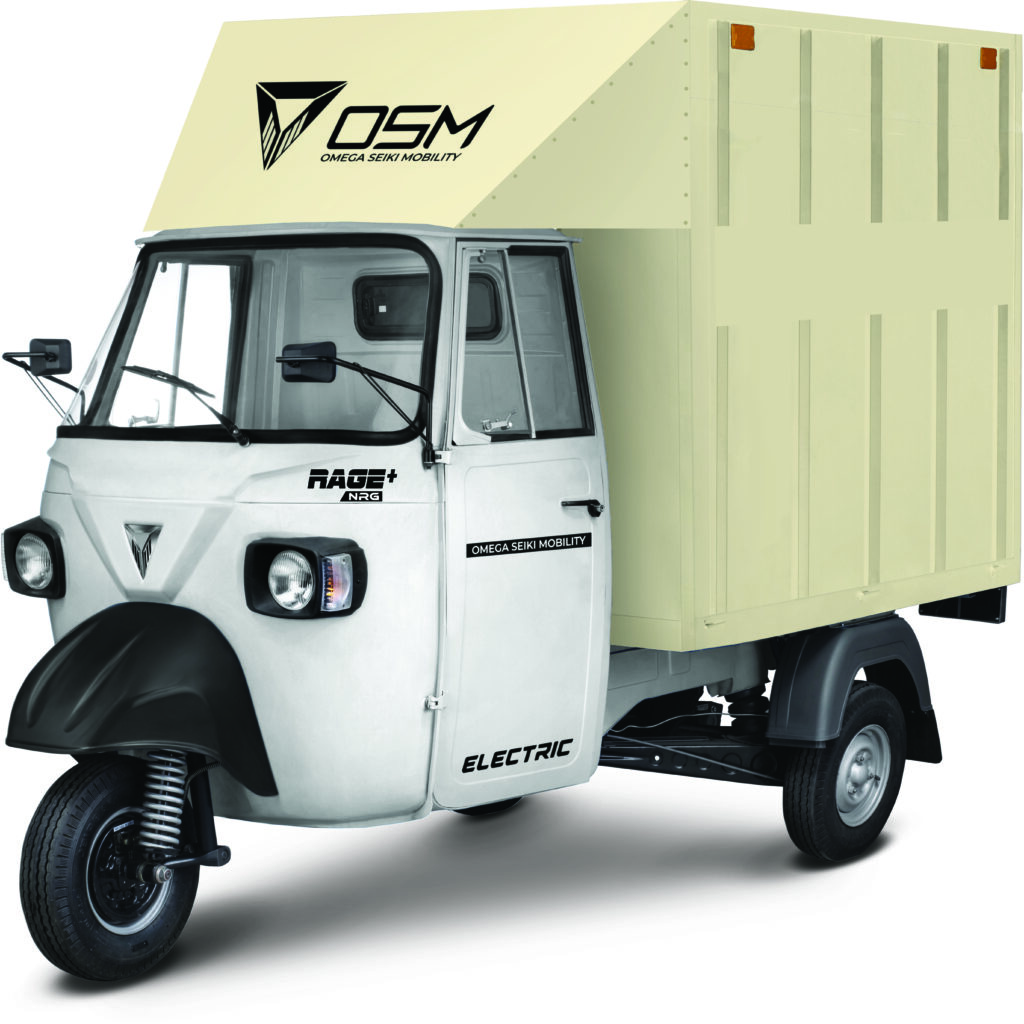
5. Omega Seiki Mobility Rage+

Omega Seiki Mobility's Rage+ is another example of how crowded the electric cargo three-wheeler space has become.
The compact vehicle is aimed at e-commerce, grocery and FMCG deliveries, where easy handling and efficient city operation are central to the business case.
It also underlines a broader shift in the market. Newer EV-focused manufacturers are finding room alongside established commercial-vehicle names, particularly in specialised last-mile applications.
These five vehicles are doing different jobs, but they point in the same direction.
Passenger three-wheelers are becoming more comfortable and more capable, while cargo models are being shaped around the realities of last-mile delivery. The familiar three-wheeler format remains, but manufacturers are getting much more specific about what sits underneath it and what the vehicle is expected to do.
That may be the more interesting part of India's electric-vehicle transition.
The headlines will continue to belong to electric cars and scooters. But on India's crowded streets, electric three-wheelers are already doing the less glamorous work — carrying commuters, delivering groceries and keeping small businesses moving.
And there are increasingly different vehicles for each of those jobs.