
MoRTH Proposes Revised Emission Norms for Agricultural and Construction Equipment Engines
The Ministry of Road Transport and Highways has issued a draft notification proposing amendments to the Central Motor Vehicles Rules, 1989. The changes revise emission standards for agricultural tractors, power tillers, combined harvesters and construction equipment vehicles, including updated limits under TREM and CEV stages, testing cycles, fuel specifications and compliance requirements.
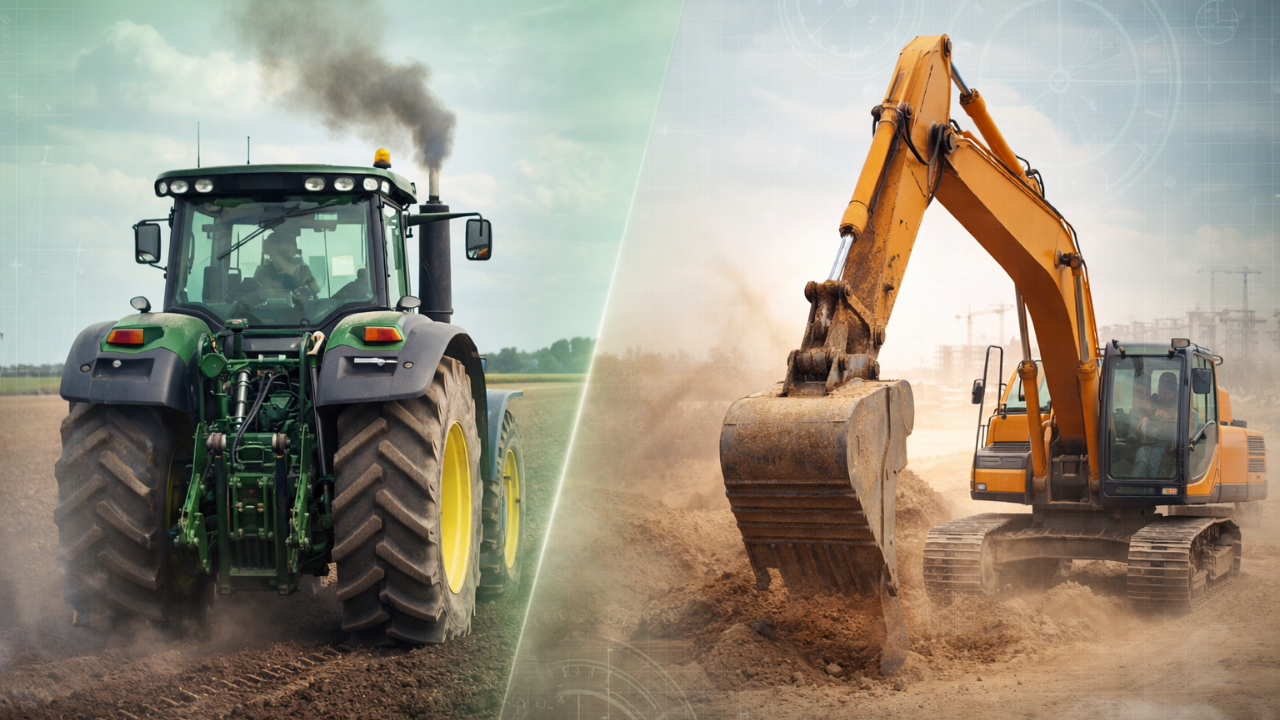
The Ministry of Road Transport and Highways issued a draft notification, proposing amendments to the Central Motor Vehicles Rules, 1989. The draft has been published in the Gazette of India and will be open for public comments for 30 days from the date copies are made available to the public.
The proposed changes have been issued under the Motor Vehicles Act, 1988. Objections and suggestions can be submitted to the Ministry within the specified period.
Revision to Rule 115A
The draft proposes changes to Rule 115A, which deals with emission of smoke and vapour from agricultural tractors, power tillers, construction equipment vehicles and combined harvesters powered by internal combustion engines.
The title of Rule 115A is proposed to be revised to clearly cover agricultural tractors, power tillers, construction equipment vehicles and combined harvesters.
Sub-rule (9) and sub-rule (10) are proposed to be substituted with updated provisions related to emission standards and testing procedures.
Updated Emission Standards for Agricultural Equipment
The draft introduces revised emission limits under TREM Stage IIIA, IV and V norms for agricultural tractors, power tillers and combined harvesters.
Emission limits for pollutants such as:
- Carbon Monoxide (CO)
- Hydrocarbons (HC)
- Nitrogen Oxides (NOx)
- Particulate Matter (PM)
- Particle Number (PN)
have been specified based on engine power categories (kW) and applicable implementation dates.
Testing will be conducted using:
- Non-Road Steady Cycle (NRSC)
- Non-Road Transient Cycle (NRTC)
For NRTC, composite emissions will be calculated by assigning 10% weight to cold start results and 90% weight to hot start results.
Hydrogen-fuelled engines are exempt from certain limits, and in cases where combined HC+NOx limits are specified, only NOx limits will apply for hydrogen internal combustion engines.
Emission Norms for Construction Equipment Vehicles (CEV)
Construction equipment vehicles will be required to comply with emission standards under CEV Stage IV and Stage V, depending on engine power and date of manufacture.
Similar to agricultural equipment, emissions will be measured over NRSC and NRTC test cycles. Separate provisions are included for compression ignition (CI) and positive ignition (PI) engines.
Limits for ammonia emissions have also been specified for engines equipped with selective catalytic reduction (SCR) systems.
Compliance and Testing Procedures
The draft specifies that:
- Testing will be conducted on engine dynamometers.
- Procedures will follow AIS-137, as amended from time to time.
- Conformity of Production (COP) requirements are defined based on annual production volume.
- Sample size for COP testing will be based on average daily production, subject to minimum and maximum limits.
Manufacturers may use defined deterioration factors or conduct durability testing as per prescribed procedures.
Vehicles must carry a conformity label meeting AIS-137 requirements.
Fuel Coverage and Specifications
The emission standards will apply to engines operating on various fuels, including:
- CNG and bio-CNG
- LNG
- LPG
- Diesel (B7)
- Ethanol blends and ED95
- Flex fuels
- Biodiesel blends
- Hydrogen
- Dual-fuel configurations
Reference fuel specifications have been detailed for each fuel type. In case reference fuels are not available, commercial fuels meeting BIS standards may be used for testing.
Specifications for hydrogen-enriched compressed natural gas (HCNG) have also been introduced in a new annexure.
Monitoring and Transition Provisions
The draft mandates monitoring of gaseous emissions for certain power categories manufactured after specified dates.
Vehicles manufactured before the implementation of revised TREM stages may be registered up to nine months after the respective enforcement date.