
Montra Eviator 350, 350L+ Electric Small Trucks Launched in India, Prices Start at Rs 14.58 Lakh
Montra Electric has added two new variants to its electric small commercial vehicle range, offering different battery capacities for urban and intercity logistics needs.
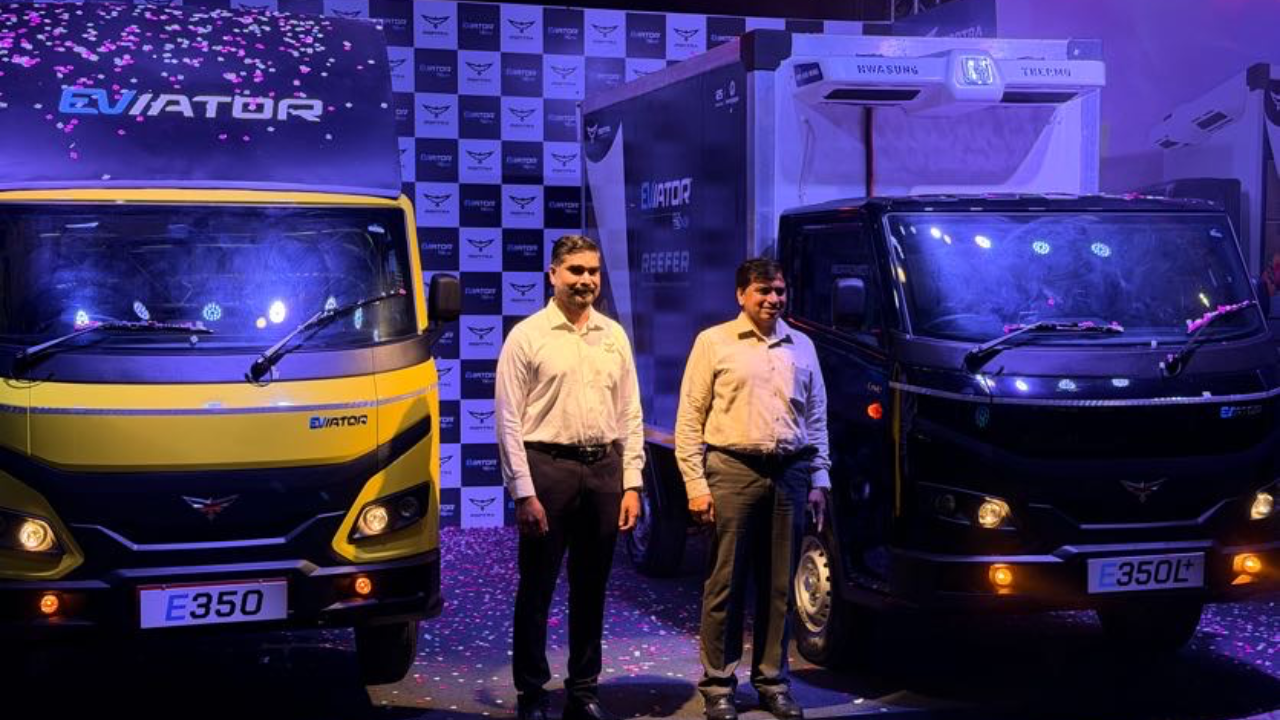
Montra Electric announced the addition of two new variants to its electric small commercial vehicle (eSCV) portfolio. The new models include the Eviator 350 with a 32 kWh battery and the Eviator 350L+ with a 50 kWh battery.
Battery Options and Range
The Eviator 350 comes with a 32 kWh battery pack and is designed for short-distance operations, with a claimed daily running capability of up to 140 km. The Eviator 350L+ is equipped with a 50 kWh battery pack. It has a certified range of over 300 km and a real-world range of more than 200 km, making it suitable for longer routes and intercity transport. The existing 40 kWh version of the Eviator continues to be part of the lineup.
Use Case-Based Positioning
The company has introduced these variants based on operational data collected from a fleet of more than 600 vehicles, which have collectively covered over 6.5 million kilometers. This data has been used to identify different usage patterns across logistics operations.
The 32 kWh variant is positioned for last-mile delivery and high-frequency urban routes, while the 50 kWh variant is aimed at applications requiring longer driving distances, including intercity logistics and specialized use cases such as refrigerated transport and municipal services.
Market Context
The expansion follows the launch of the Eviator 350L in January 2025. According to the company, that model has achieved over 30 percent market share in the 3.5-ton electric truck segment within 11 months of its launch. With the addition of the new variants, the Eviator range now includes three battery configurations: 32 kWh, 40 kWh, and 50 kWh.
Pricing and Availability
The Eviator 350 (32 kWh) is priced at Rs 14.58 lakh, while the Eviator 350L+ (50 kWh) is priced at Rs 16.86 lakh (introductory, ex-showroom). The new variants will be made available through Montra Electric dealerships. The company said dealerships will provide comparison data to help customers evaluate total cost of ownership across variants.
Elctrik Speaks
The introduction of multiple battery configurations reflects a shift toward application-based vehicle planning in the electric commercial vehicle segment. Instead of a single standard product, manufacturers are offering options aligned with specific logistics needs such as urban delivery and intercity transport. This approach may influence how fleet operators assess cost, range, and utilization in EV adoption.
Jalaj Gupta, Managing Director, Montra Electric, said, “The next phase of EV adoption will not be driven by products alone, but by how intelligently they fit into real-world operations. At Montra Electric, we have leveraged over 65 lakh kilometers of fleet data, drawn exclusively from our 600+ Eviator vehicles, to understand how different businesses use their vehicles. This has enabled us to move towards a duty-cycle-driven product strategy, delivering complete business solutions where customers can choose configurations that directly improve uptime, efficiency, and return on investment. This is a critical step in making electric mobility not just viable but scalable for commercial applications, enhancing operational efficiency while significantly reducing logistics costs.”
Saju Nair, CEO, Montra Electric (e-SCV Division) said, “Eviator has already set benchmarks in uptime and performance in the eSCV segment. With the introduction of these new variants, we are expanding the platform to address a wider spectrum of logistics needs, from last-mile efficiency to long-haul consistency. This enables fleet operators to deploy EVs with greater precision, unlock new use cases, and improve overall fleet economics, accelerating the transition to electric mobility.”