
Maruti Suzuki e Vitara vs Hyundai Creta Electric: Detailed Specs Comparison
From battery sizes and claimed range to dimensions, charging times and safety tech, here’s how the Maruti Suzuki e Vitara stacks up against the Hyundai Creta Electric on paper.
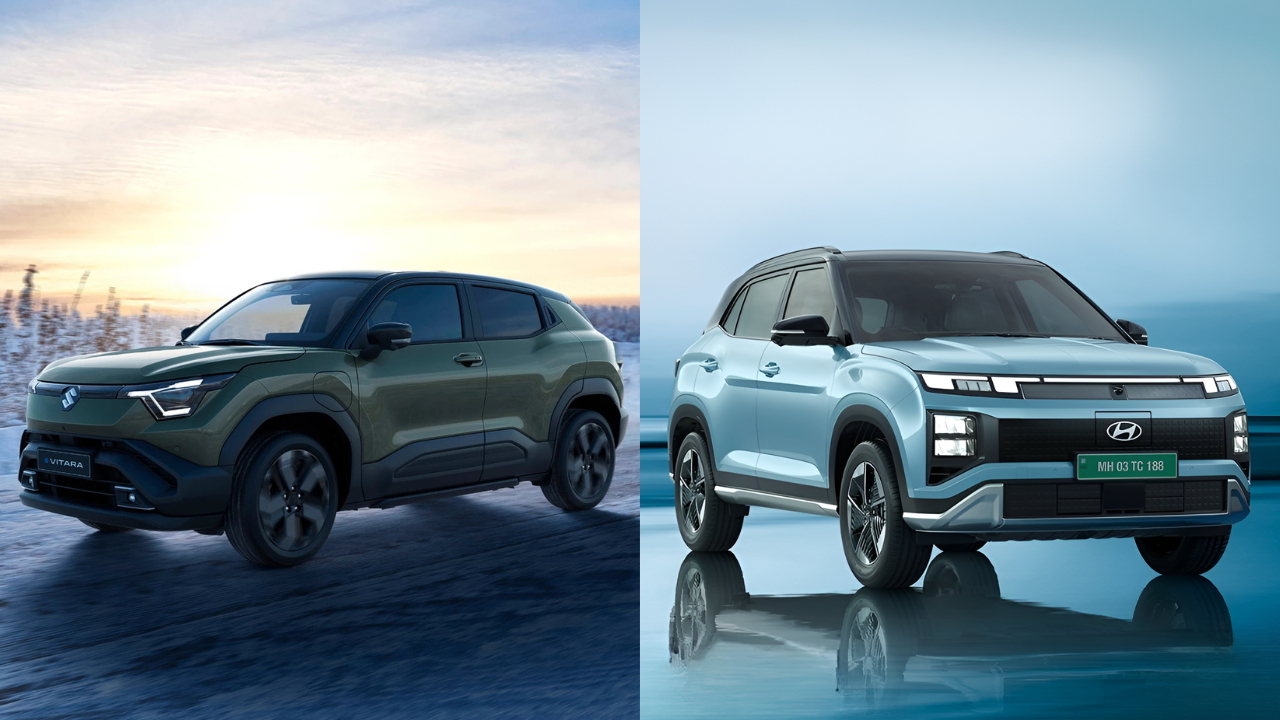
The electric compact SUV segment in India now includes two key offerings - the Maruti Suzuki e-Vitara and the Hyundai Creta Electric. Both models are front-wheel-drive electric SUVs equipped with single-speed transmissions, multiple battery choices and Level-2 ADAS. Here is a detailed, specification-based comparison.
Maruti Suzuki e Vitara vs Hyundai Creta Electric: Variants and Battery Options
The Maruti Suzuki e Vitara is available in three variants: Delta, Zeta and Alpha. The Delta variant is offered exclusively with a 49 kWh lithium iron phosphate (LFP) battery pack, while the Zeta and Alpha variants are equipped with a larger 61 kWh LFP battery pack.
The Hyundai Creta Electric, on the other hand, is offered with two battery options: a 42 kWh unit and a 51.4 kWh Long Range version. Hyundai uses a liquid-cooled lithium-ion battery pack for both configurations.
Maruti Suzuki e Vitara vs Hyundai Creta Electric: Power and Performance Figures
The e Vitara’s 49 kWh version produces 141.8 bhp and 193 Nm of torque. The 61 kWh variants generate 171.6 bhp and 193 Nm. All versions use a 3-phase AC permanent magnet synchronous motor paired with a single-speed transmission driving the front wheels.
The Creta Electric uses an Interior Permanent Magnet Synchronous Motor (IPMSM). The 42 kWh variant develops 99 kW (135 PS), while the 51.4 kWh version produces 126 kW (171 PS). It also uses a single-speed reduction gear in a front-wheel-drive configuration.
Maruti Suzuki e Vitara vs Hyundai Creta Electric: Claimed Driving Range
Maruti Suzuki claims a driving range of 440 km for the 49 kWh e Vitara and 543 km for the 61 kWh version.
Hyundai claims a range of 420 km for the 42 kWh Creta Electric and 510 km for the 51.4 kWh variant, based on the MIDC Part 1 + Part 2 test cycle.
Maruti Suzuki e Vitara vs Hyundai Creta Electric: Charging Specifications
The e Vitara takes approximately 6.5 hours to charge the 49 kWh battery using a 7.4 kW AC charger, while the 61 kWh battery requires around 9 hours. DC fast charging from 10 to 80 percent takes approximately 45 minutes for both battery options.
The Creta Electric supports CCS2 charging. With an 11 kW AC fast charger, the 42 kWh battery can be charged from 10 to 100 percent in about 4 hours, while the 51.4 kWh battery takes around 4 hours and 50 minutes. Its DC fast charging time from 10 to 80 percent is 39 minutes.
Maruti Suzuki e Vitara vs Hyundai Creta Electric: Dimensions and Kerb Weight
The e Vitara measures 4,275 mm in length, 1,800 mm in width and 1,640 mm in height, with a wheelbase of 2,700 mm. Kerb weight ranges from 1,725 kg in the Delta variant to 1,815 kg in the Alpha variant. Seating capacity is five.
The Creta Electric measures 4,340 mm in length, 1,790 mm in width and 1,655 mm in height, with a 2,610 mm wheelbase. The Creta Electric is longer and taller, while the e Vitara has a longer wheelbase.
Maruti Suzuki e Vitara vs Hyundai Creta Electric: Exterior Design
The e Vitara features three-point matrix LED daytime running lights integrated with the headlamps and LED tail lamps with a matching three-point lighting pattern. It rides on 18-inch aerodynamic alloy wheels and is offered in six monotone and four dual-tone colour options.
The Creta Electric comes with 17-inch aero alloy wheels fitted with 215/60 R17 tyres. It is available in metallic, matte and dual-tone finishes, including black roof combinations, and offers low rolling resistance tyres.
Maruti Suzuki e Vitara vs Hyundai Creta Electric: Interior and Display Features
Inside, the e Vitara is equipped with a 10.1-inch infotainment display and a 10.25-inch digital instrument cluster. It also features ventilated front seats, a 10-way power-adjustable driver’s seat, ambient lighting and wireless phone charging.
The Creta Electric features dual 10.25-inch screens for the instrument cluster and infotainment system. Additional equipment includes an electrochromic inside rear-view mirror with telematics switches, automatic headlamps, front and rear parking sensors and a rear-view monitor.
Maruti Suzuki e Vitara vs Hyundai Creta Electric: Safety Features
The e Vitara is equipped with seven airbags and Level-2 ADAS, along with a 360-degree camera system and ISOFIX child seat anchors.
The Creta Electric offers multiple airbags including driver, passenger, side and curtain units. It also includes ABS with EBD, Electronic Stability Control, Vehicle Stability Management, Hill-Start Assist Control and Hill Descent Control. Hyundai SmartSense Level-2 ADAS functions include Forward Collision Avoidance Assist, Lane Keeping Assist, Smart Cruise Control with Stop and Go, Blind Spot Collision Avoidance Assist and Rear Cross Traffic Collision Avoidance Assist.
Maruti Suzuki e Vitara vs Hyundai Creta Electric: Pricing
The Maruti Suzuki e Vitara is priced from Rs 15.99 lakh (ex-showroom, Delhi) for the Delta 49 kWh variant. The Zeta 61 kWh is priced at Rs 17.49 lakh, while the Alpha 61 kWh costs Rs 19.79 lakh. The Alpha 61 kWh Dual Tone variant is priced at Rs 20.01 lakh. The company states that these introductory prices include the home charger, installation and survey charges.
The Hyundai Creta Electric is priced from Rs 18.02 lakh (ex-showroom).