
Electric Mobility Is No Longer a Green Dream — It Is India’s Economic Necessity
Trucks and buses make up just 4% of the total vehicle population on our roads. Yet, despite their small numbers, they account for nearly 55% of fuel...

Authored by :Shikher Dubey
At a recent conference I attended, a speaker shared a statistic that was both surprising and deeply concerning.
Trucks and buses make up just 4% of the total vehicle population on our roads. Yet, despite their small numbers, they account for nearly 55% of fuel consumption and contribute to over 50% of pollution.
Let that sink in.
This puts into perspective a recent appeal by the Prime Minister, urging citizens to reduce the use of petrol and diesel vehicles over the next year. His message was largely directed at personal vehicle owners, and he even set an example by reducing his own convoy size.
The significance of that statement lies not in symbolism, but in what it quietly acknowledges: India’s oil dependence has become a macroeconomic vulnerability.
India is today the world’s third-largest oil importer, and its import dependence touched a record 88.2% in FY25. Every spike in crude prices weakens the rupee, widens the current-account deficit, fuels inflation and raises logistics costs across the economy. In a nation where transport costs ripple into food prices and household budgets almost immediately, oil is not merely an energy commodity. It is an inflation transmitter.
This is why the EV transition can no longer be treated as a niche urban lifestyle trend for affluent consumers in Bengaluru or Gurgaon. It is becoming central to India’s economic resilience.
But this raises an important question:
Can we realistically reduce the use of Diesel trucks and buses?
The answer is simple — absolutely not.
These vehicles are the backbone of the economy. From food supplies to essential goods, everything depends on them. Any attempt to reduce their usage would bring economic activity to a standstill.
So, if we can’t reduce them…
what’s the solution?
The answer isn’t unknown. In fact, it’s quite straightforward
Electric trucks and buses (EVs).
However, the reality today is far from ideal.
- India currently has only around 1,200–1,500 EV trucks
- And roughly 10,000–12,000 electric buses
That’s a tiny fraction compared to the scale required.
The shift to electric freight and public transport is not as easy as it sounds. Several roadblocks remain:
- Lack of EV infrastructure on highways
- High initial cost of EV trucks and buses
- Operational and logistical challenges
That said, both the government and private sector are now accelerating efforts in this space.
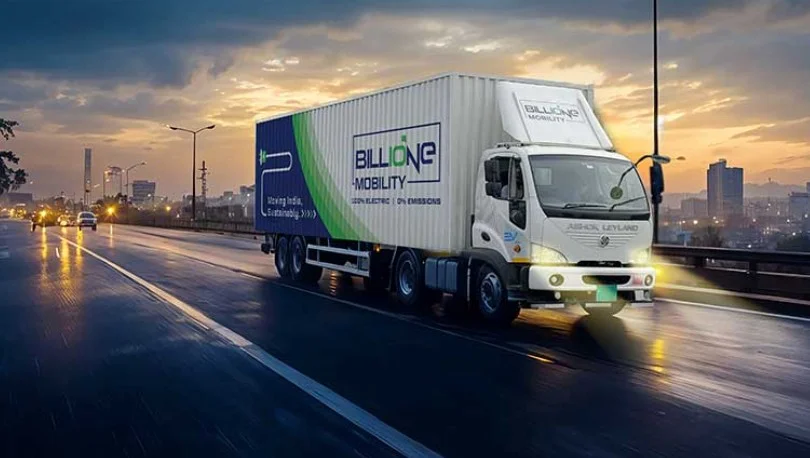
One such emerging private player is BillionE, a company pioneering EV trucking solutions.
Starting such a venture is no small feat — especially without external funding or government backing. Yet, they’ve managed to do just that. Currently operating around 150 EV trucks Planning to add 400 more within the next six months.
This is the kind of bold, forward-thinking approach India needs more of.
India’s dependence on fossil fuels is immense. But by accelerating EV adoption in freight and public transport, we’re not just solving one problem — we’re tackling many at once:
- Reducing pollution
- Lowering fuel dependency
- Cutting long-term costs
- Building a sustainable future
In other words, we’re not hitting two birds with one stone —
we’re solving multiple challenges in one strategic move.
Charging infrastructure is still inadequate outside major cities. Apartment residents often struggle to install private chargers. State-level incentives are shrinking. And India risks replacing one import dependency with another: crude oil may eventually give way to imported battery cells, rare-earth minerals and Chinese supply chains.
That is the central contradiction of India’s energy transition. An EV ecosystem without deep domestic manufacturing merely changes the geography of dependence.
The challenge, therefore, is not simply to sell more electric scooters or cars. It is to build an industrial ecosystem around batteries, semiconductors, grid infrastructure and energy storage. In that sense, the EV race resembles India’s telecom revolution or digital-payments push: the real prize is not the hardware itself, but strategic control over the ecosystem.
There is also a political irony embedded in the current fuel debate. For years, environmental arguments struggled to persuade Indian consumers to abandon petrol and diesel. But inflation might succeed where climate activism could not.
History suggests that nations rarely transition away from dominant energy systems because of morality alone. They do so when economics becomes unbearable.
That moment may now be arriving for India.
(Disclaimer: The views and opinions expressed in this article are solely those of Shikher Dubey, VP Sales & Marketing at Charge Zone and do not necessarily reflect the official stance of Elctrik. The publication is intended for informational and discussion purposes only.)